


Soft or Firm Pillow for Side Sleepers: Which One Actually Works
Choosing a soft or firm pillow for side sleepers matters more than it does for any other sleep position. When you lie on your side, your shoulder creates a real gap between your head and the mattress. Your pillow has one job: fill that gap and hold it through the night. Get the firmness wrong and your neck compensates for 7 hours straight.
For most side sleepers, medium-firm to firm is the right choice. Soft pillows feel comfortable when you first lie down but compress under your head's weight, dropping your neck out of alignment as the night goes on. The sections below explain why — and how your shoulder width and mattress firmness change the exact answer for your body.

Table of Contents
Is a Soft or Firm Pillow Better for Side Sleepers?
A firm pillow for side sleepers is almost always the better option. The reason is geometric. On your side, your shoulder is propped up and your head floats above the mattress. Your pillow fills that space. If it can't hold its shape under your head's weight, your neck gradually tilts toward the mattress — and the muscles along the side of your neck start compensating. Hold that position for six to eight hours and you get the stiffness, soreness, and base-of-skull headaches that most side sleepers accept as just part of sleeping.
A firm pillow prevents that drop. It stays at the height your neck needs, keeping your cervical spine in a neutral line from your ear to your hip. A systematic review on pillow design and spinal alignment[1] identified maintaining correct loft and support throughout the night as the key factor in reducing neck pain and improving sleep quality — not the initial comfort feel when you first lie down.
Soft pillows compress easily and feel immediately comfortable, which is why most people choose them in a store. But that initial softness is exactly the problem. A soft pillow for side sleepers doesn't stay at the height you need. It sinks under your head's weight and loses its loft progressively through the night, leaving your neck unsupported exactly when your muscles are trying to rest.
How Shoulder Width Changes Your Pillow Firmness

Shoulder width is the variable most soft or firm pillow for side sleepers guides skip entirely. Wider shoulders create a larger gap between your head and the mattress, so you need more loft — and a firmer fill to maintain it. Narrower shoulders need less loft and can get by with slightly less firmness. This is why two people can try the same pillow and have completely different outcomes.
Sleep Foundation guidance[2] recommends 4 to 6 inches of loft for side sleepers, with broader frames landing toward the higher end. Use these starting points:
- Narrow shoulders (under 16 inches): ~4 inches of loft, medium firmness
- Average shoulders (16–18 inches): 4–5 inches of loft, medium-firm
- Broad shoulders (over 18 inches): 5–6 inches of loft, firm
The loft and firmness are linked — the more height a pillow needs to maintain, the firmer the fill has to be to hold it without compressing. A low-density foam in a tall pillow will collapse under your head and give you the same problem as a soft pillow at any height.
For a full method to measure your exact loft requirement before buying, see the guide on pillow height for side sleepers — the towel stack test takes five minutes and gives you a specific number to shop against.
How Your Mattress Affects the Firmness You Need
Your mattress firmness directly shifts how much pillow loft and firmness you need — and nearly every soft or firm pillow for side sleepers guide ignores this. On a soft mattress, your shoulder sinks 1 to 2 inches into the surface. That reduces the gap your pillow has to fill, so you can use a slightly lower loft and softer support. On a firm mattress, your shoulder stays elevated, the gap is larger, and you need a firmer and taller pillow to compensate.
The practical rule: soft mattress = lower loft, softer support. Firm mattress = taller loft, firmer support. A side sleeper may need a 6-inch firm pillow on a hard mattress but only a 4-inch medium-firm pillow on a soft one. Ignoring this is one of the most common reasons people buy a "recommended" pillow and still wake up sore.
If you recently changed your mattress and your neck has gotten worse since, the problem isn't the new mattress — it's that your old pillow is now the wrong firmness and height for the new sleeping surface. Adjust the pillow to match the mattress, not the other way around.
How you position your pillow while side sleeping also affects how much of that gap your head actually needs to bridge — whether you hug a pillow, tuck it under your arm, or sleep with your arm under your head changes the effective height requirement.
What Wrong Firmness Does — and the Best Fills for Side Sleepers

Both extremes cause problems. A pillow that's too soft for side sleeping lets your head sink toward the mattress, bending your neck and building tension through the night — producing the stiffness, shoulder ache, and morning headaches most side sleepers are familiar with. A pillow that's too firm pushes your head too high, straining the opposite side of your neck and creating pressure on your ear and temple. That second problem gets less attention, but it can directly contribute to inner ear pain when sleeping on your side.
A 2025 systematic review in Rehabilitacion[3] confirmed that pillow design significantly affects pain, disability, and sleep quality in people with chronic neck pain — and that compression failure is a key factor. A pillow that can't hold its height fails you slowly through the night.
Fill material determines how consistently any pillow maintains its firmness. For a firm pillow for side sleepers, the fill options that actually hold their shape are:
- High-density memory foam: Conforms to your head shape while maintaining its loft. Solid memory foam gives firm, consistent support. Shredded memory foam is more adjustable if you need to fine-tune your height.
- Latex: Naturally springy and resists compression better than foam over time. Also runs cooler than memory foam — useful for side sleepers who overheat. See the full comparison of latex vs. memory foam for side sleepers.
- Down and polyester: Compress too easily and too quickly. They feel soft and light but flatten within an hour of lying on them — the worst choice for the firmness a side sleeper needs.
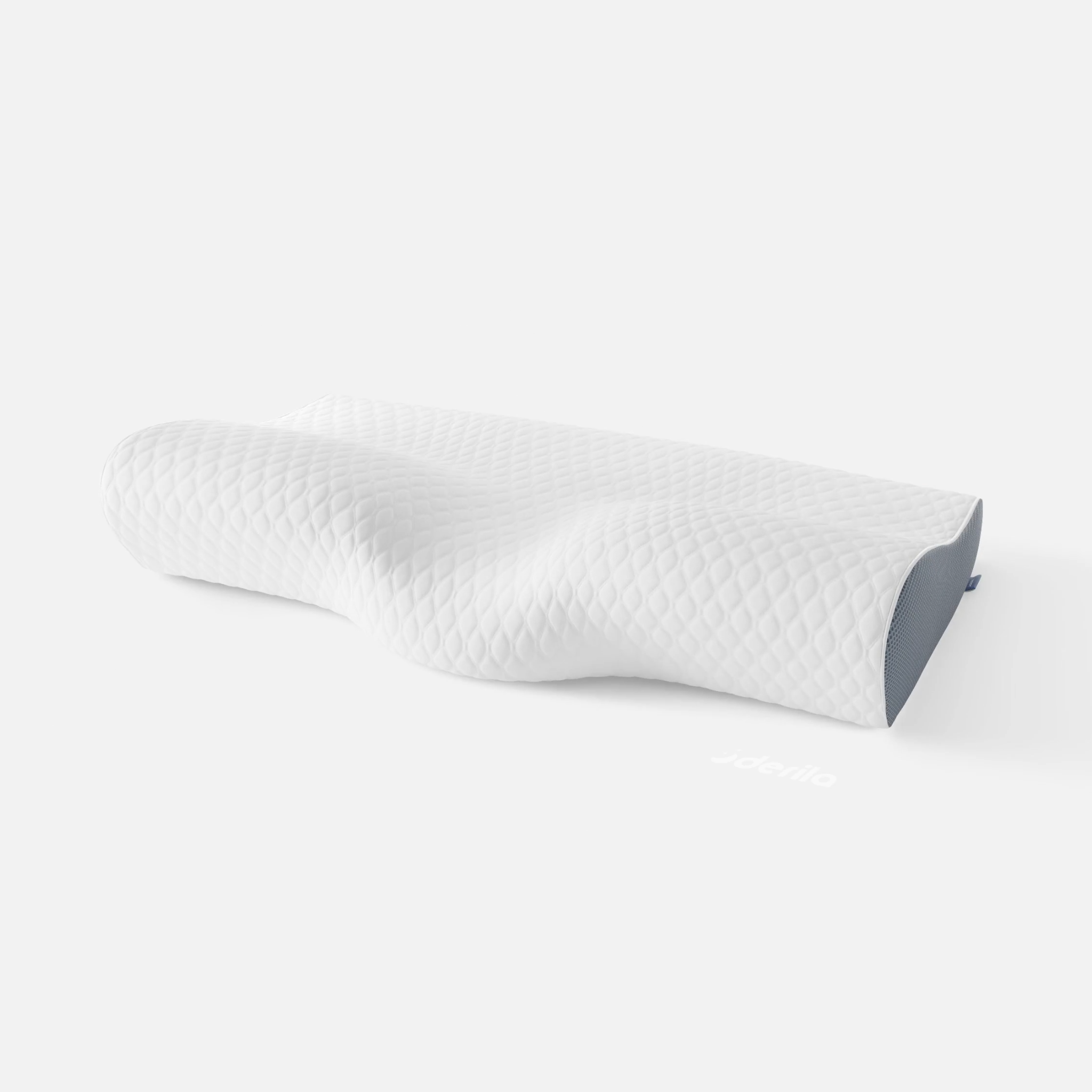
The Derila side sleeper pillow uses a certified high-density memory foam that holds its loft through the night, built specifically for the support requirements of side sleeping. It's designed to stay at the height your neck needs from the time you fall asleep to the time you wake up.
Frequently Asked Questions
Is a soft pillow bad for side sleepers?
Not automatically, but usually yes. A soft pillow for side sleepers compresses under the weight of your head and loses the height your neck needs to stay aligned with your spine. The initial feel is comfortable, but by the middle of the night the pillow has flattened enough to leave your neck in a bent position. Medium-firm to firm is the right range for most side sleepers.
What firmness pillow is best for side sleepers?
Medium-firm to firm works for most side sleepers. Your specific answer depends on your shoulder width and your mattress firmness. Broader shoulders and firmer mattresses call for a firmer, taller pillow. Narrower shoulders or a soft mattress usually need less. Use the shoulder width guide above as your starting point and adjust from there.
Can a pillow be too firm for a side sleeper?
Yes. A pillow that's too firm for your body type pushes your head too high, straining the muscles on the opposite side of your neck. It can also create sustained pressure on your ear and temple during the night. The goal isn't maximum firmness — it's the firmness that holds your head level with your shoulder without creating new pressure points.
How do I know if my pillow firmness is wrong?
If your pillow is too soft: you wake with neck stiffness, shoulder soreness, or a headache at the base of the skull that improves during the day. If it's too firm: you notice ear or temple pressure during the night, jaw tension, or soreness on the side of your neck you weren't sleeping on. A visible head tilt toward the mattress when you lie down is the clearest sign the pillow is too soft.
Does pillow fill type matter for side sleeper firmness?
Significantly. Fill determines how consistently the pillow holds its firmness through the night. High-density memory foam and latex both hold their shape reliably — they're the best options for side sleepers who need consistent support from bedtime to morning. Down and polyester fills compress quickly and are the worst choice for anyone who needs a firm pillow for side sleeping.
References
- "Effect of Different Pillow Designs on Promoting Sleep Comfort, Quality, and Spinal Alignment: A Systematic Review." Journal of Bodywork and Movement Therapies (2020). sciencedirect.com
- "Best Pillow for Side Sleepers." Sleep Foundation. sleepfoundation.org
- Ghosh S, Goyal M, Goyal K. "Effect of Pillow on Pain, Disability and Sleep Quality in Patients with Chronic Neck Pain: A Systematic Review." Rehabilitacion 59, no. 3 (2025): 100922. pubmed.ncbi.nlm.nih.gov/40633255/