


Why Am I a Side Sleeper? The Real Reasons
Why am I a side sleeper? Because your body found a position that works. Side sleeping keeps your airway open, puts your spine in a more neutral position, and lets your brain clear waste more efficiently overnight. These aren't small advantages — they're the reasons your body gravitates there and keeps returning even when you try other positions.
Around 60 to 63% of adults default to side sleeping. It's the most common sleep position globally, and not by accident. The reasons people land there — and stay there — are more interesting than most assume.
Table of Contents

Why Are Most People Side Sleepers?
Side sleeping became the global default because no other position combines airway patency, spinal alignment, and digestive comfort at once. The explanation runs from evolutionary biology to your body's own night-by-night self-correction.
From an evolutionary standpoint, sleeping on your side mirrors how primates rest. A curled or lateral posture protects the front of the body, keeps limbs mobile for a fast response, and lets the head rest without requiring a fully relaxed neck. Modern humans don't face the same threats, but the instinct still shapes how the body settles.
More practically: side sleeping keeps the tongue and soft tissue in the throat pulled forward instead of falling backward into the airway. It gives the hips and shoulders a surface to share the load, letting the lumbar spine decompress. And for digestion, the lateral position means gravity isn't working against your stomach's natural drainage.
For many people, becoming a side sleeper wasn't a decision — it was an adaptation. If you snore, have acid reflux, or wake up with back pain in other positions, your nervous system likely shifted you toward your side over time. You didn't read about the benefits and decide to change. Your body kept waking you up in positions that caused problems until it found one that didn't.
Johns Hopkins Medicine identifies side sleeping as the best position for most people with snoring and back pain[1], and notes that back sleeping is the worst option for people whose airways narrow during sleep. If your body moved you toward the side, it was solving a problem. Understanding your side sleeper pillow position is often the next thing the body figures out — finding the angle that holds this new default without strain.
What Does Side Sleeping Do to Your Brain?
Side sleeping activates the brain's waste-clearance system more effectively than any other position. The glymphatic network — your brain's overnight cleaning crew — flushes out metabolic byproducts while you sleep, including amyloid beta, the protein linked to Alzheimer's disease.
A landmark study in the Journal of Neuroscience[2] used MRI to compare glymphatic efficiency across all sleep positions. Side sleeping activated the system most effectively — waste proteins cleared significantly faster than in back or stomach sleeping.
The mechanism: while you sleep, cerebrospinal fluid flows through channels in the brain and sweeps out metabolic waste that builds up during the day. Research published in Science[3] confirmed this system operates at roughly 90% higher capacity during sleep than during waking hours. A 2020 review in Brain Sciences[4] confirmed that body position during sleep is one of the lifestyle factors that directly affects how effectively this clearance runs.
The caveat: much of the position-specific research was conducted in rodent models, and human studies are still in early stages. But the direction is clear. Your brain — not just your body — has a stake in which position you sleep in.
Which Health Conditions Make You a Side Sleeper?
Specific health conditions are among the strongest predictors of why someone becomes a side sleeper. In most cases, the body self-corrects toward whatever position produces the least nighttime disruption.
Acid reflux and heartburn. Lying flat on your back gives stomach acid a direct path upward into the esophagus. Side sleeping — especially on the left — uses gravity to keep acid where it belongs. Many people with reflux become side sleepers without ever identifying the reason.
Snoring and sleep apnea. On your back, the tongue and soft palate fall backward and narrow the airway. Side sleeping pulls them forward and keeps the passage open. If you snore significantly on your back but not on your side, your nervous system solved the problem on its own.
Back pain. Sleeping flat with no accommodation for the hips and shoulders aggravates disc pressure and lumbar tension. Side sleeping — especially with a pillow between the knees — distributes load across the joints and takes pressure off the lower spine. Chronic back pain is one of the most common reasons people migrate to their side over time.
Pregnancy. In the second and third trimesters, lying on the back places the uterus's weight on the aorta and reduces blood flow. The body shifts toward side sleeping instinctively, and healthcare providers actively recommend it. Getting pillow height right becomes especially important as the body changes and the shoulder-to-neck gap shifts.
If any of these apply to your history, that's likely why you're a side sleeper. The position wasn't arbitrary — it was functional.
Does It Matter Which Side You Sleep On?
Yes — more than most people expect. Left-side and right-side sleeping produce noticeably different effects on digestion, circulation, and organ function, based on where your organs actually sit.
The stomach sits to the left of center. The liver sits on the right. The inferior vena cava — the main vein returning blood to the heart — runs along the right side of the spine. These positions matter when you spend six to eight hours with your bodyweight on one side.
Left-side sleeping keeps the stomach's gastric outlet lower, helps acid stay down, and avoids compressing the inferior vena cava. Right-side sleeping raises the stomach above the esophageal valve and slightly compresses that vein. The full case for left-side sleeping covers each mechanism. There are also specific reasons right-side sleeping works against your anatomy worth knowing if you tend to favor that side.
A note on sleep position and personality: the popular framework linking sleep position to character traits (log, yearner, fetal, soldier) was developed in the early 2000s and received significant press coverage, but the research was small and never replicated in controlled studies. Sleep position is primarily driven by physical comfort, body mechanics, and health conditions — not temperament. What your position does tell you is something about your body's needs.
If you don't have a clinical reason to sleep on the right, left is the more anatomy-backed default.
Frequently Asked Questions
Why do I only feel comfortable sleeping on my side?
Your body has adapted to side sleeping because it solves something specific — an open airway, relief from back pain, reduced acid reflux, or better spinal alignment. Over time, the nervous system reinforces positions that feel safer and more sustainable. Side sleeping wins on most of those terms for most people. It's not just preference. It's usually a physical optimization.
Is it bad that I'm a side sleeper?
No. Side sleeping is the most common sleep position and is associated with real health benefits: airway openness, reduced back pain, better glymphatic clearance, and improved digestion. The two variables to get right are which side you're on (left is generally better) and whether your pillow supports the position correctly — the wrong height puts stress on the neck and shoulder through the night.
Can you train yourself to stop side sleeping?
Technically yes, but it's difficult and usually not worth the effort unless a specific medical reason requires it. Your body has good reasons for choosing this position. Switching to back sleeping typically increases snoring and can worsen acid reflux for people who are prone to either. The position your body defaults to is usually the right one to support, not fight.
Why do I always end up on my side even when I start on my back?
Your body is responding to physical signals — a narrowing airway, increased lumbar pressure, or slight acid discomfort. These sensations don't always wake you fully, but they're enough to trigger a position change. Returning to your side repeatedly is a sign your body finds it more sustainable than the position you started in. It's the nervous system solving the problem quietly.
Does it matter if I sleep in the fetal position vs. stretched out on my side?
Both work. A tight curl can put more sustained pressure on the hips and knees and may restrict breathing if very pronounced. A more extended side position tends to be easier on the joints over a full night. In either case, the most important factor is spinal alignment — which depends on pillow height at the head and a firm surface between the knees. Check the guide on soft or firm pillow for side sleepers for how firmness affects alignment.
What kind of pillow does a side sleeper need?
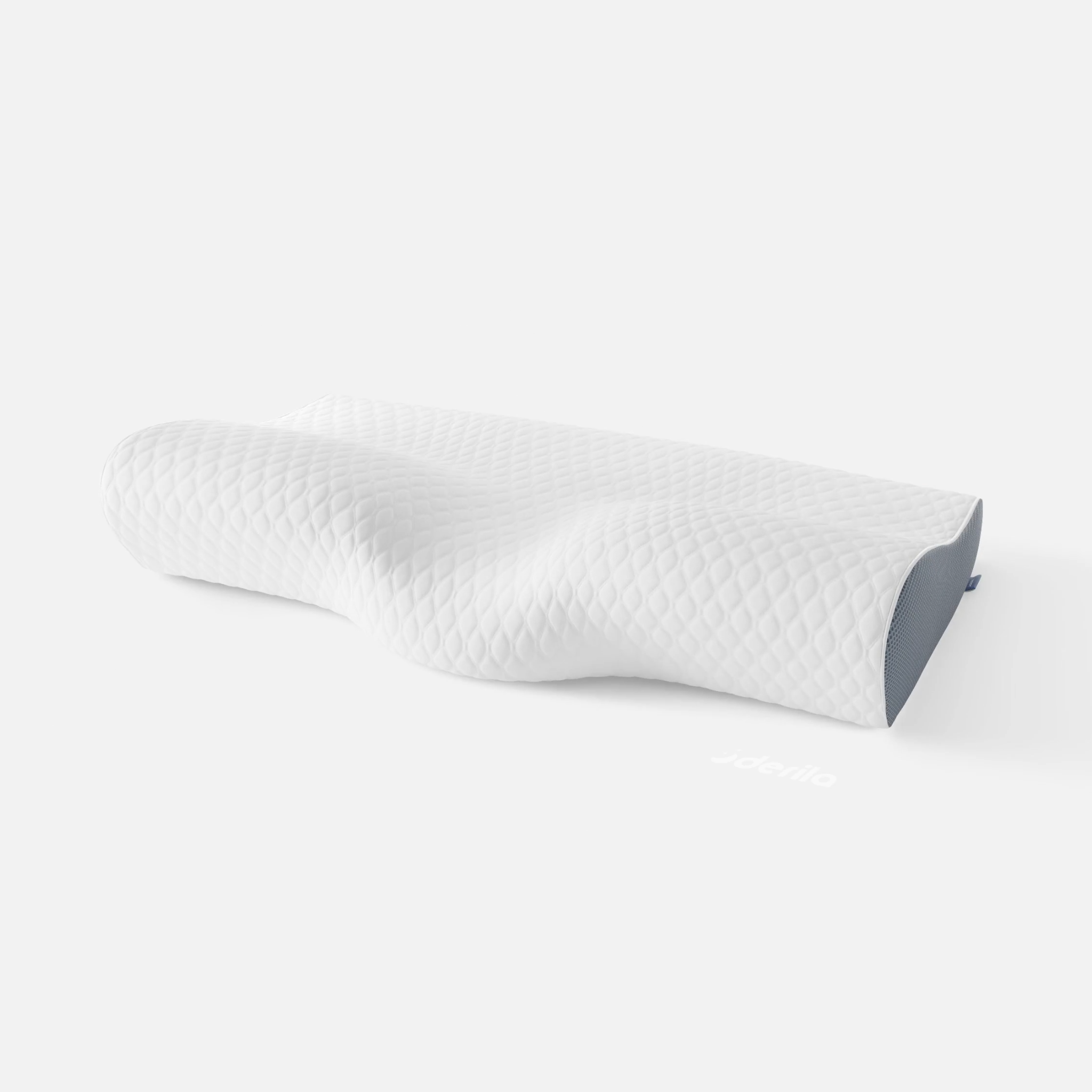
Side sleepers need a pillow tall enough to fill the gap between the mattress and the ear — which is wider than for back or stomach sleepers because the shoulder adds height. If the pillow is too short, the neck tilts down; too tall, and it tilts up. Both create tension that builds through the night. The Derila side sleeper pillow is built around this gap — the shoulder-to-ear distance, the lateral load, and the loft retention needed to hold the position through the night. Pillow height for side sleepers covers how to measure your specific gap.
References
- Johns Hopkins Medicine. "Choosing the Best Sleep Position." hopkinsmedicine.org
- Lee H, Xie L, Yu M, Benveniste H, et al. "The Effect of Body Posture on Brain Glymphatic Transport." Journal of Neuroscience 35, no. 31 (2015): 11034–11044. jneurosci.org
- Xie L, Kang H, Xu Q, et al. "Sleep Drives Metabolite Clearance from the Adult Brain." Science 342, no. 6156 (2013): 373–377. ncbi.nlm.nih.gov
- Reddy OC, van der Werf YD. "The Sleeping Brain: Harnessing the Power of the Glymphatic System through Lifestyle Choices." Brain Sciences 10, no. 11 (2020): 868. pmc.ncbi.nlm.nih.gov