


Side Sleeper Pillow Position: The Complete Setup for Better Sleep
The correct side sleeper pillow position requires support in at least three places — your head, your knees, and your arms. Most side sleepers only think about the head pillow. That solves half the problem. The other half is your hips and shoulders, and skipping it means spending eight hours accumulating spinal tension that shows up as stiffness by morning.
Two or three pillows arranged correctly is the full fix. No new mattress. No specialist appointment.
Table of Contents
Why Side Sleeper Pillow Position Matters

A correct side sleeper pillow position keeps your spine in a straight, neutral line from hips to neck. Your head pillow fills the gap between your ear and the mattress. A knee pillow keeps your hips level. Both together stop your spine from sagging or twisting through the night. Miss either one and your muscles compensate — which is why you wake up sore even after a full eight hours.
Side sleepers carry most of their body weight through one shoulder and one hip. Without support across those pressure points, the spine falls out of alignment. Research in Healthcare confirms that pillow height and position significantly affect cervical spine curvature during side sleeping[1]. Even small misalignments at the neck compound across eight hours because your muscles are constantly correcting.
A randomized comparative trial in the Journal of Multidisciplinary Healthcare[2] found that pillow type meaningfully alters cervicothoracic spinal posture in side-lying positions. It's not just about comfort. The way your pillow holds your head changes the shape of your spine while you sleep — and that shape determines what you feel in the morning.
A body pillow to hug adds a third layer: it keeps your top arm from pulling forward and internally rotating the shoulder joint. It also anchors you on your side through the night. Getting your side sleeping position right starts with understanding why the body needs support at each of these three zones.
How to Position Your Head Pillow
Your head pillow should be tucked snugly between your shoulder and the base of your neck — not pushed down under the shoulder. The goal is to bring the mattress surface up to meet your head so your neck stays horizontal. If your ear tips toward the mattress, the pillow is too thin.
A quick visual check: lie on your side and have someone look from behind. Your ear, shoulder, and hip should form a straight vertical line. Head tilting up means the pillow is too thick. Head drooping down means it has gone flat.
Research on pillow height biomechanics[3] shows that incorrect pillow height increases cranio-cervical pressure and disrupts cervical alignment — both of which produce morning pain. A study comparing pillow heights on cervicothoracic spine parameters[4] also found that pillow height shifts as material compresses under body weight — a soft feather pillow can sink enough to move you out of alignment by midnight.
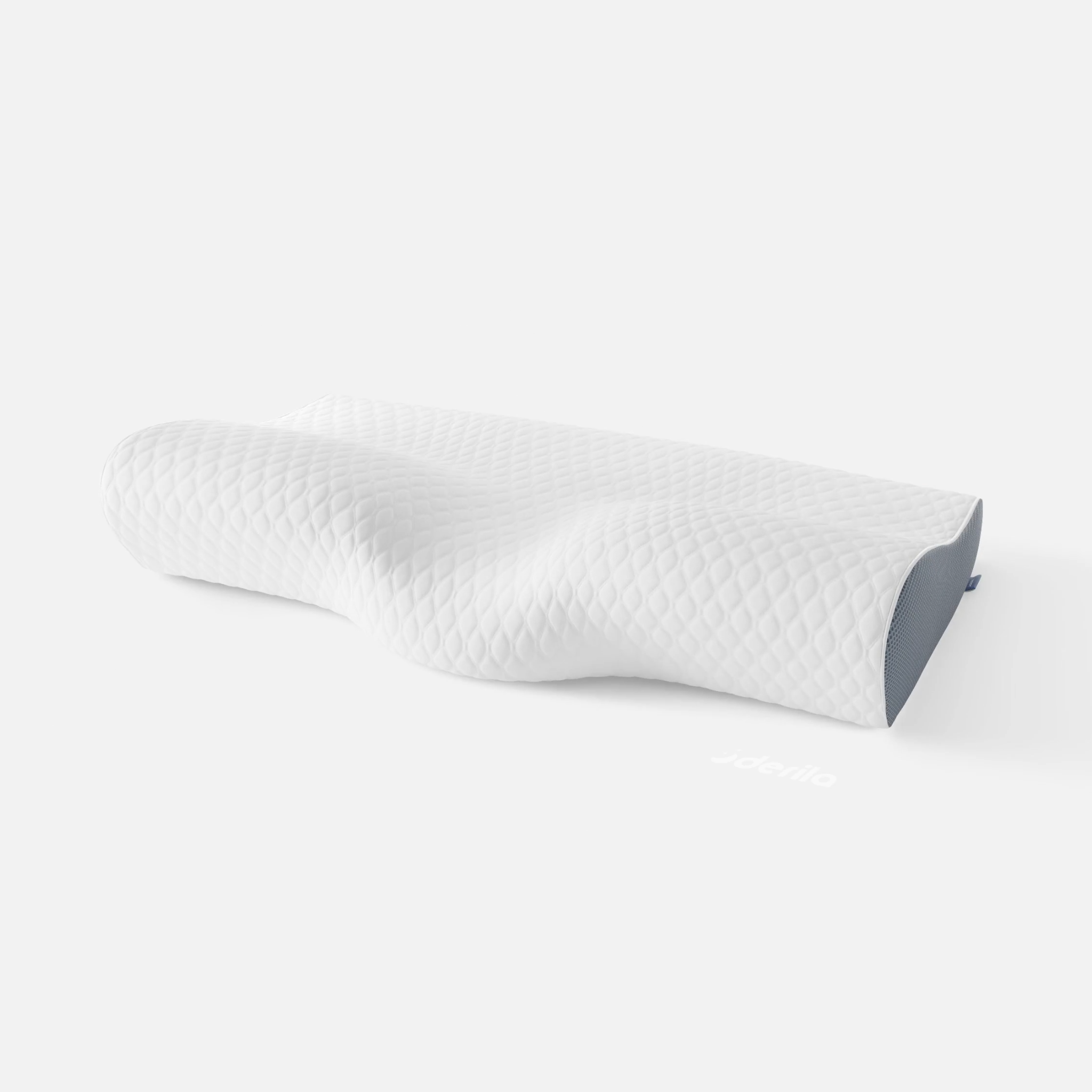
Finding the right loft for your shoulder width takes under a minute and makes a noticeable difference. The Derila side sleeper pillow is built specifically with the loft needed to bridge the shoulder-to-ear gap without compressing down by morning. How memory foam compares to latex for overnight loft retention matters more than most people realize when choosing a head pillow material — a pillow that holds its height is essential for maintaining your side sleeper pillow position through the night.
Knees, Arms, and the Full Setup
The knee pillow makes more difference than most people expect. When you sleep on your side without one, your top leg falls forward and rotates your pelvis. That pulls the lower spine out of its natural curve. A pillow between your knees stops that rotation and keeps your hips stacked level.
The Sleep Foundation notes[5] that a pillow between the knees maintains natural hip and pelvic alignment and reduces lower back strain. The Mayo Clinic recommends[6] that side sleepers draw their knees up and place a firm pillow between them to reduce lower back stress. A regular pillow folded in half works fine. If you have lower back or hip discomfort, extend it down the full leg rather than just the knees. Leg elevation while side sleeping takes this further for circulation issues or swelling.
Your arms need attention too. The shoulder you're lying on takes the most pressure in any side sleeper pillow position. If the head pillow isn't tall enough, that shoulder gets compressed into the mattress and the neck cranks sideways to compensate. Physical therapists note[7] that side sleepers often press directly onto the rotator cuff tendons for hours, leading to inflammation and morning pain. Research on arm numbness during side sleeping[8] recommends keeping the bottom elbow slightly in front of your body rather than pinned underneath — this relieves nerve compression through the shoulder and armpit. Hugging a body pillow with your top arm keeps it forward without rotating the shoulder joint overnight.
Putting it all together takes four steps:
- Fix your head pillow. It should sit at your neck, not under your shoulder, and hold its loft through the night. The Derila side sleeper pillow is built for the shoulder-to-ear gap. Whether soft or firm works better for you depends on shoulder width and sleep style.
- Add a pillow between your knees. Fold a standard pillow in half or use a dedicated knee pillow. Place it so your top leg doesn't fall forward. This one change alone often resolves lower back pain within a few nights.
- Sort out your arms. Keep your bottom elbow slightly forward. Hug a body pillow with your top arm to hold it in a neutral position.
- Check in the morning. Neck stiffness means adjust pillow height first. Lower back ache means move the knee pillow higher onto the thighs, or use a firmer one.
Most people notice a real difference within three to four nights.
How Your Sleep Style Changes the Setup
Most side sleepers fall into one of three positions — fetal, log, or yearner — and each shifts the ideal side sleeper pillow position slightly.
Fetal position (knees pulled toward chest): Your hips are already somewhat flexed, so spinal rotation is a smaller risk than in a straight position. The knee pillow is still useful, but a softer one works since your legs naturally stay closer together. The main risk is curling too tightly — it compresses the chest and strains the lumbar spine. Don't tuck your chin into your chest.
Log position (legs straight): Your body is fully extended, so you need a firmer, well-lofted head pillow to keep the neck fully level. The knee pillow matters more here because straight legs don't naturally stay stacked the way bent legs do.
Yearner position (arms stretched forward): Arms reaching forward pull the shoulders into internal rotation over time. Use a body pillow between your arms — rather than hugged to your chest — to keep both shoulders in a more neutral forward position.
Which side you sleep on also matters beyond pillow setup. Left-side sleeping supports digestion, acid reflux reduction, and cardiac circulation in ways the right side doesn't. If both sides feel equally comfortable, left is the more anatomy-backed default.
Frequently Asked Questions
What is the correct pillow position for side sleepers?
Your head pillow should sit between your shoulder and the base of your neck, filling the gap so your neck stays level with your spine. A second pillow between your knees prevents your hips from rotating and keeps your lower spine aligned. These two placements form the foundation of a healthy side sleeper pillow position. A third pillow to hug with your top arm completes the setup.
Should a side sleeper's pillow go under the shoulder?
No. Your pillow should rest at the side of your head and neck, not underneath your shoulder. Placing it under the shoulder lifts one side of your upper body and angles your neck downward. Your shoulder rests on the mattress while the pillow bridges the gap between the mattress surface and your head.
How many pillows does a side sleeper need?
At least two: one under the head and one between the knees. A third to hug provides arm and shoulder support and helps keep you anchored on your side through the night. Three pillows is a solid baseline. Specific needs shift based on body width, sleep style, and any existing pain.
Why do I wake up with neck pain even though I sleep on my side?
The most common cause is a head pillow at the wrong height. Too thin — your neck sags toward the mattress. Too thick — your neck bends upward. Both create muscle strain that builds over eight hours. A pillow designed specifically for side sleepers, with enough loft to fill the shoulder-to-head gap, typically resolves this quickly. Check the guide on pillow height for side sleepers to measure your gap.
Does sleeping on your side hurt your shoulder?
It can — if the head pillow is too flat. When the pillow doesn't lift your head enough, your body weight presses directly onto the shoulder joint and compresses the rotator cuff tendons for hours. A taller head pillow takes that load off the joint. Keeping your bottom elbow slightly in front of your body rather than pinned underneath also helps by reducing nerve compression in the shoulder and armpit.
References
- Koo TTK, et al. "Ergonomic Consideration in Pillow Height Determinants and Evaluation." Healthcare 9, no. 10 (2021): 1333. pmc.ncbi.nlm.nih.gov/articles/PMC8544534/
- Gordon SJ, Grimmer-Somers KA, Trott PH. "A Randomized, Comparative Trial: Does Pillow Type Alter Cervico-Thoracic Spinal Posture When Side Lying?" Journal of Multidisciplinary Healthcare 4 (2011): 321–327. pubmed.ncbi.nlm.nih.gov/21966226/
- Ren S, Wong DW, Yang H, Zhou Y, Lin J, Zhang M. "Effect of Pillow Height on the Biomechanics of the Head-Neck Complex." PeerJ 4 (2016): e2397. pmc.ncbi.nlm.nih.gov/articles/PMC5012320/
- Kim HC, Jun HS, Kim JH, et al. "The Effect of Different Pillow Heights on the Parameters of Cervicothoracic Spine Segments." Korean Journal of Spine 12, no. 3 (2015): 135–138. pmc.ncbi.nlm.nih.gov/articles/PMC4623167/
- Sleep Foundation. "Sleeping with a Pillow Between Your Knees." sleepfoundation.org
- Mayo Clinic. "Sleeping Positions." Back Pain In-Depth. mayoclinic.org
- Limitless Physical Therapy. "Shoulder Pain from Sleeping on Side: Causes and Fixes." limitlesspts.com
- MedCline. "Pillow for Arm Numbness." medcline.com