


Pillow Height for Side Sleepers: How High Should Your Pillow Be?
Pillow height for side sleepers is the single most overlooked factor in sleep quality and morning neck pain. Most side sleepers blame their mattress or their position — but the problem is sitting right under their head. Get the loft wrong and your muscles work instead of rest for 7 hours straight.

Table of Contents
Why Pillow Height for Side Sleepers Matters
Pillow height — also called loft — is how thick your pillow sits when you lie on it. Research on cervical spine biomechanics[1] confirms that pillow height directly controls how your cervical spine aligns with your body during sleep. Too low and your head tilts toward the mattress. Too high and your neck bends sharply upward. Either way, your muscles take the strain instead of resting.
For side sleepers, loft is the most important pillow specification — more important than fill material, cover fabric, or brand. When you're on your side, your shoulder creates a gap between your ear and the mattress. Your pillow's job is to fill that gap precisely so your head stays level and your spine runs in one straight, neutral line. If the loft is off by even an inch, your neck is bent all night.
Back sleepers can tolerate a wider range of heights because the shoulder-to-ear gap is smaller. Side sleepers have no such margin. Getting the right pillow height for side sleeping is non-negotiable if you want to wake up without stiffness.
The Best Pillow Height for Side Sleepers
Most side sleepers need a pillow between 4 and 6 inches tall to maintain neutral spinal alignment. A randomized controlled study[2] found that a medium individualized-height pillow produced the cervical curve closest to natural standing alignment and the lowest musculoskeletal stress of any height tested. A systematic review in the Journal of Bodywork and Movement Therapies[3] found moderate evidence that 7 to 11 centimeters of unloaded loft best supported lateral sleepers — which translates to roughly 5 to 7 inches once compressed under head weight.
Your shoulder width determines where you land within that range. The gap between your ear and the outside of your shoulder is exactly the space your pillow needs to fill — and that gap varies significantly between people. Amerisleep's pillow height research[4] notes this shoulder-to-neck gap falls between 4 and 6 inches for most adults, with broader-shouldered people often needing an additional inch or two.
A quick way to estimate your gap: stand with your shoulder blade against a wall. The distance from the wall to the side of your neck is your reference number. Broader frames typically land near 6 to 7 inches of needed loft. Smaller frames usually sit in the 4 to 5 inch range.
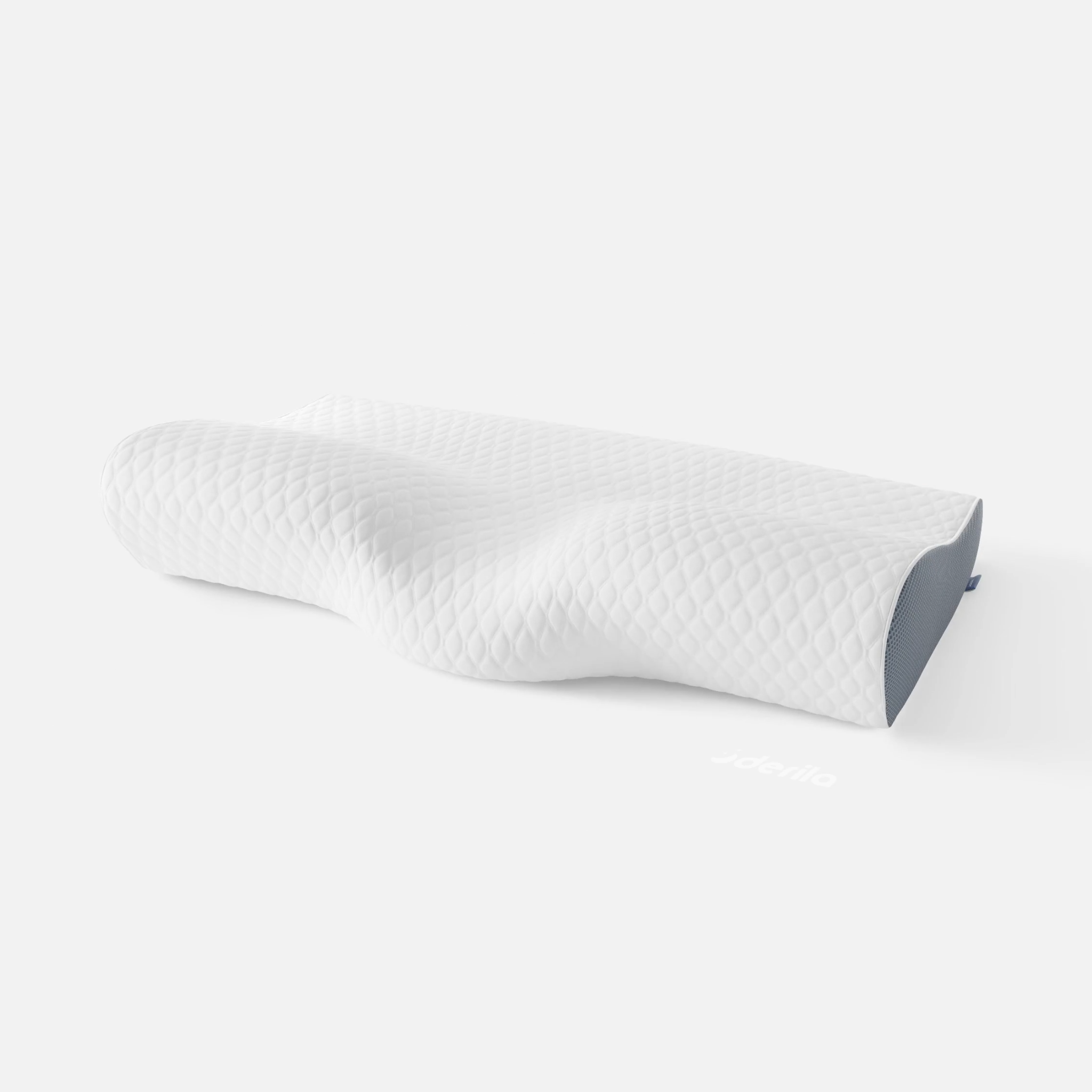
The Derila side sleeper pillow is designed around this loft range. Its high-density memory foam maintains the correct height throughout the night without the collapse that makes most pillows lose their loft by 3 a.m. For a comparison of how fill materials handle compression, see the guide on latex vs. memory foam for side sleepers.
How Mattress Firmness Changes the Height You Need
Mattress firmness directly shifts the loft you need — and most pillow height guides for side sleepers ignore this completely. On a soft mattress, your shoulder sinks 1 to 2 inches into the surface, which shrinks the gap your pillow has to fill. On a firm mattress, your shoulder stays elevated, creating a larger gap that requires more loft.
Research on adjustable pillow design[5] found that changing your mattress without adjusting your pillow is one of the most common triggers of new neck pain. If you recently bought a new mattress and your neck has been worse since, your pillow height is the likely cause — not the mattress itself.
The rule is simple: softer mattress = lower loft, firmer mattress = higher loft. If you're also deciding between a soft and firm pillow fill, the guide on soft vs. firm pillows for side sleepers covers how fill firmness and loft interact.
How to Find Your Pillow Height at Home
Before testing anything, look for these signs that your current pillow height for side sleeping is wrong:
- Neck stiffness or aching that's worst in the morning and eases off within a few hours
- A headache at the base of the skull on waking
- Numbness or tingling in one arm during the night
- Waking more frequently than usual without an obvious reason
Harvard Health[6] confirms that pillow-related neck pain is typically worst in the morning and improves within a few hours — a pattern that distinguishes it from injury. Kinetic Restoration's research[7] identifies arm numbness at night as another overlooked indicator of pillow misalignment.
If any of these apply, use the towel stack method to find your correct pillow height for side sleepers before buying a new pillow:
- Lie on your mattress on your side in your normal sleep position.
- Fold 3–4 bath towels into thick squares and place them under your head.
- Start with one folded towel. Add or remove folds until your head feels level and your shoulder stays perpendicular to the mattress.
- When your position feels neutral and your neck isn't angling up or down, measure the stack height. That number is your target loft.
Hexham Family Chiropractic recommends this method[8] as the most reliable pre-purchase test — it accounts for your specific shoulder width and mattress firmness at the same time. Once you have your number, you can match it against a pillow's stated uncompressed loft and know before buying whether it'll work for your body.
How you position your pillow while side sleeping also affects how much support you feel, even at the correct loft. And if you often wake with hip or lower back discomfort, elevating your legs while side sleeping can reduce the spinal compensation that feeds into neck and shoulder tension.
Frequently Asked Questions
Is a higher pillow always better for side sleepers?
No. Too much pillow height for side sleeping forces your neck to bend upward — the same strain as too little, just in the opposite direction. The goal is a neutral spine where your ear is level with your shoulder. Most side sleepers land in the 4 to 6 inch range, but broad-shouldered sleepers may need 6 to 7 inches.
Can the wrong pillow height cause headaches?
Yes. A misaligned pillow holds your neck in tension for hours, which commonly causes tension headaches that peak in the morning and fade as the day progresses. Harvard Health[6] identifies this morning-peak pattern as a clear sign the pillow — not an underlying condition — is responsible.
What pillow height works if I switch between side and back sleeping?
Side sleeping needs 4 to 6+ inches; back sleeping works best around 3 to 4 inches. A fixed-loft pillow will be a compromise for both positions. Research on sleep position changes[9] found that adjustable-loft designs helped combination sleepers maintain better alignment across position shifts during the night.
What pillow height do broad-shouldered side sleepers need?
Broad-shouldered side sleepers generally need 6 to 7 inches of loft to fill the larger ear-to-shoulder gap. On a soft mattress, you may need slightly less since the shoulder sinks into the surface. Use the towel stack method to find your specific number before buying — body build varies enough that a general recommendation won't be precise enough.
How often should I replace my pillow?
Every 1 to 2 years. Pillow fill compresses gradually over time, and a pillow that once measured 6 inches of loft may now sit at 4. If your pillow folds flat without springing back, or if you've had it for more than 2 years and your neck has been gradually worsening, the pillow has lost its side sleeper loft and needs replacing. Also see: why you're a side sleeper and what that means for your pillow needs long-term.
References
- Ren S, Wong DWC, Yang H, et al. "Effect of Pillow Height on the Biomechanics of the Head-Neck Complex." PeerJ (2016). pmc.ncbi.nlm.nih.gov/articles/PMC5012320/
- Jeon MY, Jeong HC, Lee SW, et al. "Improving the Quality of Sleep with an Optimal Pillow." Tohoku Journal of Experimental Medicine (2014). pubmed.ncbi.nlm.nih.gov/25008402/
- "Effect of Different Pillow Designs on Spinal Alignment." Journal of Bodywork and Movement Therapies (2020). sciencedirect.com
- Amerisleep. "How High Should Your Pillow Be?" amerisleep.com
- Blissbury. "Adjustable Pillow Height Guide." blissbury.com
- Harvard Health. "Is Your Pillow Hurting Your Health?" health.harvard.edu
- Kinetic Restoration. "Your Pillow Is Making Your Neck Pain Worse." kineticrestorationva.com
- Hexham Family Chiropractic. "How to Find Your Correct Pillow Height Using Towels." hexhamchiropractic.co.uk
- Blissbury. "Study: How Pillow Design Affects Sleep Position Changes." blissbury.com